

At our October meeting on October 24 at the Congregational Church of Littleton, we welcomed Elke Jahns-Harms, Theresa’s backyard neighbor, for her talk “Magical Monarchs.” Elke teaches international development at the Fletcher School at Tufts, and about eight or nine years ago she and her husband Garth found an egg on a plant they had grown for butterflies and decided to see what would happen. They have since raised about 200 monarchs. The program was planned by Theresa Campbell and coordinated by the LCG Program Committee. We also had members from the Groton and Boxboro clubs in attendance.
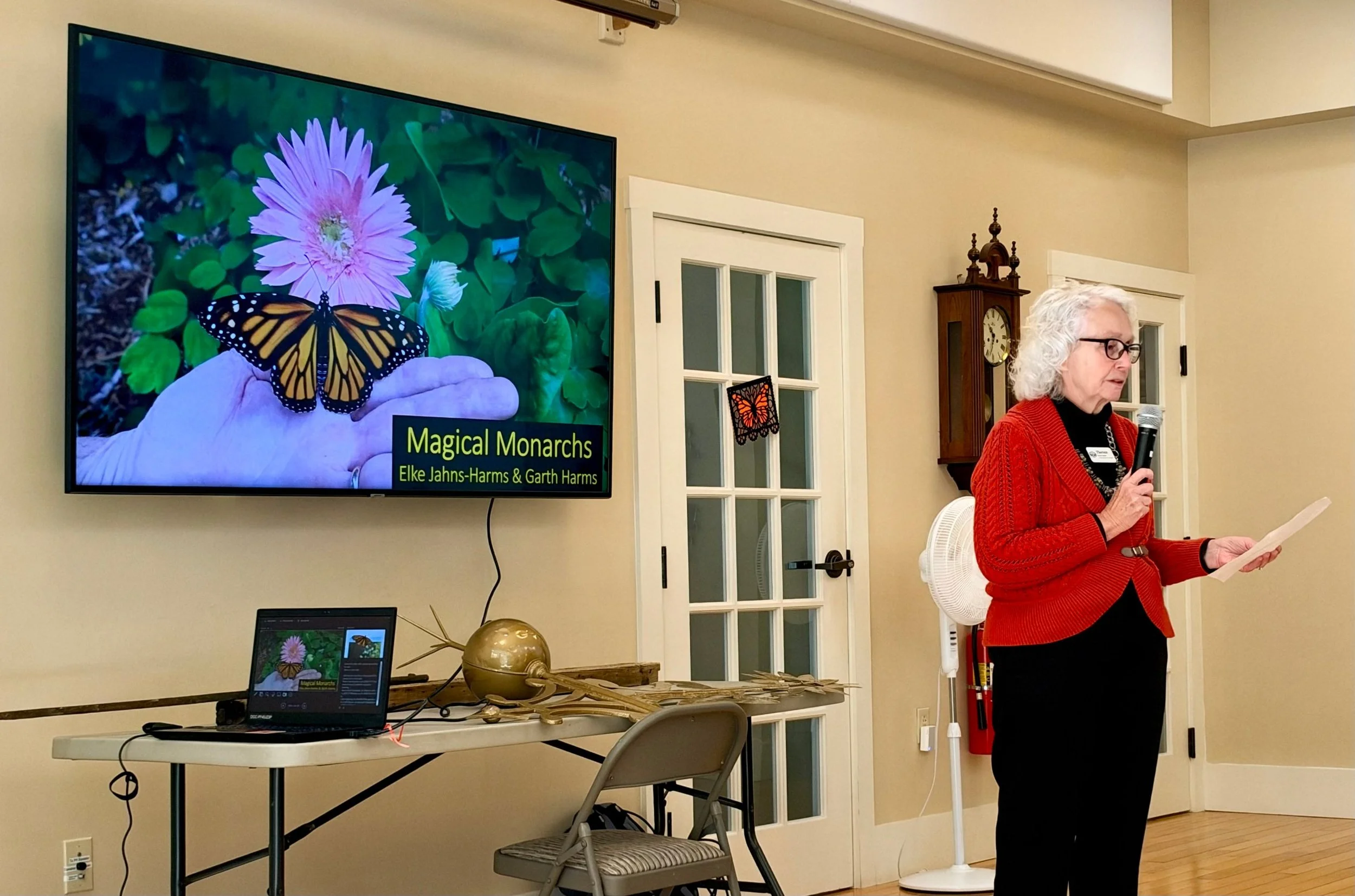
Theresa Campbell introduces Elke, her neighbor and friend.
Highlights from the presentation are summarized below.
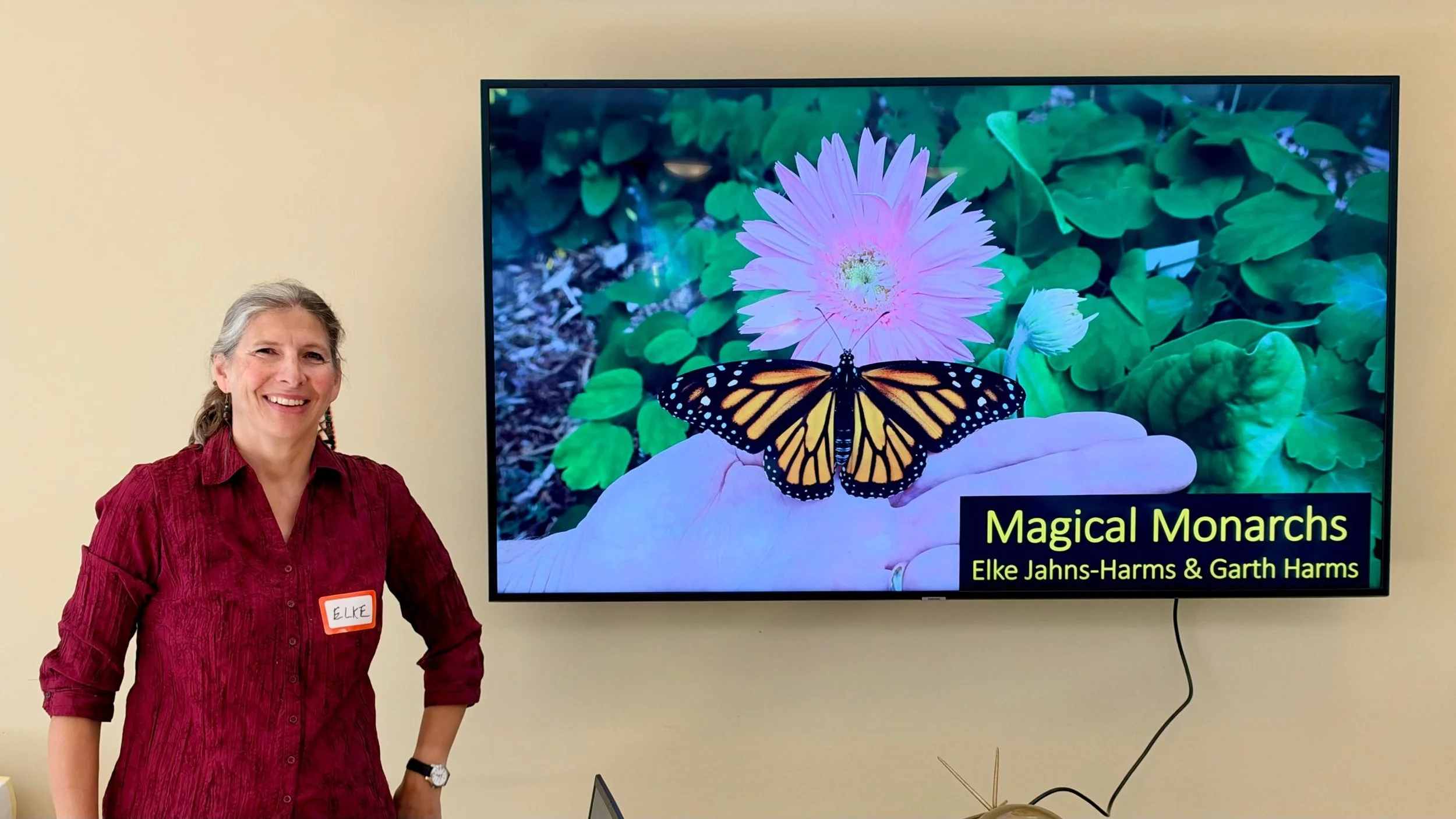
Elke with the title slide of her presentation, Magical Monarchs.
The Monarch Life Cycle
• Egg: 3 to 4 days. Caterpillar: 10 to 14 days. Chrysalis: 10 to 14 days. Heat speeds everything up (9 or 10 days in a heat wave), and a cool spell slows it down.
• The female lays one egg per leaf, on the underside of the tender leaves near the top. This spacing matters because large caterpillars eat a great deal and young caterpillars are cannibalistic.
• A brand-new caterpillar’s first meal is its own eggshell.
• Tiny caterpillars chew a little circle around themselves on the leaf. Milkweed sap is under so much pressure it can actually drown them, and the circle relieves it.
• A caterpillar molts five times in about two weeks, and the full-grown one weighs 3,000 times what it did at hatching. If a human baby grew that fast, it would be the size of a school bus in two weeks.
• When it finishes feeding, it wanders in search of a suitable spot and hangs in a J shape. Anyone raising caterpillars indoors should keep the enclosure lid closed at this stage.
• The chrysalis is smooth jade green with gold dots that really sparkle. Jewelers make copies out of jade and 14k gold.
• A chrysalis is not a cocoon. Moths spin a soft silk cocoon around themselves. Butterflies form a hard chrysalis right out of their own skin.
• The chrysalis turns dark the night before, then see-through a few hours before the butterfly comes out. As Elke noted, “A watched chrysalis never ecloses.”
• The wings don’t grow after it emerges. The butterfly pumps fluid from its fat body into its crumpled wings to unfurl them. Its tongue starts out as two separate strands that zip together into one.
• After about three hours it’s ready to fly. At that stage it will readily step onto an offered finger. It should never be picked up by the wings.
The Migrating “Super Generation”
• Summer monarchs live just 2 to 5 weeks as butterflies, and we get three or four generations a summer.
• The last generation of the year lives 8 to 9 months. Shorter, cooler days trigger a slowed-down state (diapause), and these are the ones that migrate.
• They fly up to 3,000 miles to central Mexico, 50 to 100 miles a day, often riding thermals a mile up. They navigate with the sun and Earth’s magnetic field.
• Along the way they sometimes roost in the very same trees their great-great-great-grandparents used.
• They spend the winter on just a few acres of fir forest at a very specific elevation. They cluster by the millions, and the weight can snap branches.
• In March they wake up, mate, fly to the southern US, lay eggs, and die. Their children and grandchildren arrive in Massachusetts in June. In four of the past five years, Elke saw her first monarch of the season in her own garden on July 7.
• A group of butterflies is called a kaleidoscope.
• Radio tagging shows the route isn’t a tidy highway. Some monarchs have been tracked out over the ocean before finding land again.
Identifying Males, Females, and Viceroys
• Females have thicker, darker wing veins. Males have thinner veins and two small black spots on the hind wings.
• The viceroy looks almost identical but has an extra black line across the hind wing, is a bit smaller, and has a quicker, more erratic flight. Monarchs typically flap, flap, and glide.
• A useful rule: an orange and black butterfly seen here in May is not a monarch.
• Monarchs taste bad to birds because of the milkweed they eat. Viceroys are also distasteful. Looking alike helps both, since a blue jay only needs to learn that lesson once.
Are Monarchs in Trouble?
The short answer is yes. The main threats Elke listed:
• Illegal logging and development at the Mexican winter sites
• Climate change, including storms, droughts, and migration cues that come too early or too late
• Loss of milkweed to development and farming (many people still treat it as a weed)
• Pesticides and herbicides on milkweed and nectar plants
Scientists count monarchs by how many acres they cover in Mexico each winter. The numbers bounce a lot year to year (that’s weather), with a downward trend underneath (that’s habitat loss). The encouraging news is that monarchs are resilient. A female lays 100 to 300 eggs, so they can bounce back if they have the habitat. More people planting milkweed is helping.
Choosing the Right Milkweed
Monarch caterpillars eat only milkweed. It needs to be native. California planted lots of tropical milkweed, which didn’t die back at the right time and confused the migration.
• Common milkweed: The Forest Service calls it a “super plant” because about 500 species use it. It spreads aggressively by underground rhizomes. Elke noted that hers escaped a bed surrounded by concrete. If it gets mildewy, cut it back before July for fresh growth, and check for eggs first.
• Swamp milkweed: Elke’s longtime favorite, visited by honey bees, native bees, hummingbird moths, hummingbirds, and swallowtails. Likes average to moist soil and handles a little shade. Doesn’t spread much.
• Butterfly weed: Bright orange, loves sandy, poor soil, very drought tolerant. Once established, it needs no watering. Not to be confused with butterfly bush, which is a nectar magnet but not a host plant.
• Timing tip: Sow milkweed seeds outdoors in late fall. They need winter cold to germinate. Simply scatter the seeds (cover lightly with soil if you wish). Note that it usually takes 2 to 3 years for milkweeds to flower after starting from seed. (They can still serve as caterpillar food before then, though one large caterpillar will make short work of a small seedling.) If you don’t want to wait that long, you can usually find swamp milkweed (Asclepias incarnata) and butterfly weed (Asclepias tuberosa) at local nurseries.
Nectar Plants for Adult Butterflies
Most milkweed is done blooming when the late-summer butterflies are here, so they need other nectar. Elke’s native picks: ironweed, false ageratum (“covered with butterflies”), echinacea, rudbeckia, heliopsis, Joe Pye weed, and coreopsis. For annuals, zinnias, marigolds, heliotrope, verbena, and lantana all work. Choose true native types over flashy cultivars like ‘Razzmatazz’ when you can, since showy breeding can mean less nectar and pollen.
Other butterflies have their own host plants. Black swallowtails lay eggs on dill, parsley, and Queen Anne’s lace, and their chrysalis looks like a shriveled bit of bark.
Become a Monarch Waystation
Certification is straightforward. Requirements include milkweed (about seven plants), nectar plants that bloom at different times, and a simple plan to maintain the space without pesticides. Certified gardens receive a yard sign, which Elke finds is a good way to start conversations with neighbors.
Raising Monarchs at Home
• In the wild, only 1 to 5% of monarch eggs survive to become butterflies. Predators and parasites range from protozoa to wasps to ladybugs.
• Raised indoors, survival jumps to about 95%.
• Elke does not encourage everyone to raise monarchs, but for those who do, she recommends that they raise just a few, collect eggs from the wild, use fresh milkweed, clean the cage often, and release the butterflies where and when the eggs were found. Scientists worry about large commercial breeders and wedding releases spreading disease and inbreeding.
• She offers a detailed tip sheet by email on request.
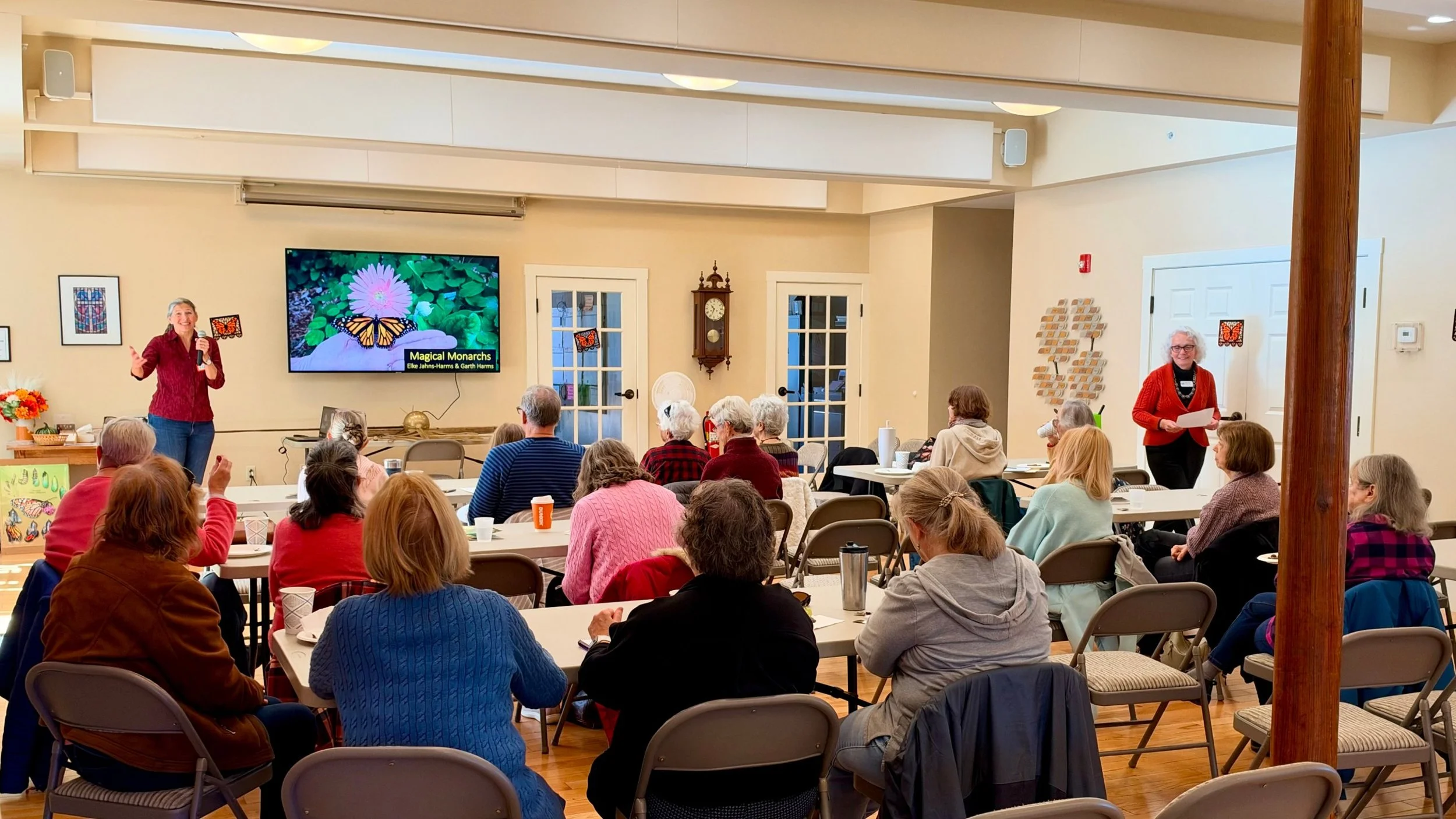
A full house of LCG members and guests from the Groton and Boxboro clubs.
Stories from the Talk
Elke also shared several personal stories:
• Milagrita. Out of their first 100 monarchs, only one couldn’t fly. While Elke was away, Garth carried the butterfly around the garden flower to flower so she could taste them all. The next morning she flew out of the cage, wobbly but flying. They named her Milagrita, “little miracle.” A week later Garth spotted her in the garden, wings still bent, flitting around like any other butterfly.
• The 2020 monarch station. During lockdown they set up a whiteboard in their front yard with daily updates on their caterpillars. Families from other neighborhoods started walking by to check on progress, and neighbors gathered for the release.
• Christmas in August. A friend dropped off 20 eggs and caterpillars before a trip. They all formed chrysalises on the same day and all emerged the same morning.
• The courtyard butterfly. A teacher friend raised monarchs with her middle school class. At the release, a student known for running everywhere at top speed took the butterfly and tiptoed it across the courtyard to a red flower. Four years later, that student handed the teacher a homemade card with a drawn monarch “in memory of the butterfly we released together.”
Elke closed by reflecting that while we all learned the butterfly life cycle in grade school, no one told us how magical it feels to have one step onto your finger.
The club thanks Elke, along with Theresa Campbell and the Program Committee, for an excellent program. Members who took home her milkweed seeds are encouraged to sow them this fall.
